
In Dec 2023, the International Organization for Standardization (ISO) published ISO 42001, the world’s first international standard specifically designed for artificial intelligence management systems. This landmark standard arrives at a critical juncture as organizations across industries grapple with implementing AI technologies responsibly, ethically, and effectively. Whether your organization is just beginning to explore AI capabilities or already has sophisticated AI systems in production, understanding ISO 42001 has become essential in today’s rapidly evolving technology landscape.
ISO 42001 is structured into 10 main clauses, covering areas such as organizational context, leadership, planning, support, operation, performance evaluation, and improvement. In addition to these clauses, the standard includes Annex A, which lists 38 AI-specific controls.
In this multipart blog series, we will thoroughly explore each clause and control of ISO 42001. In today’s post, we’ll begin by understanding what ISO 42001 is and take an in-depth look at Clause 4.
What Is ISO 42001?
ISO 42001 establishes requirements for planning, implementing, maintaining, and continuously improving an artificial intelligence management system (AIMS) within an organizational context. Much like how ISO 9001 standardizes quality management and ISO 27001 addresses information security, ISO 42001 provides a structured framework specifically tailored to the unique challenges of AI governance.
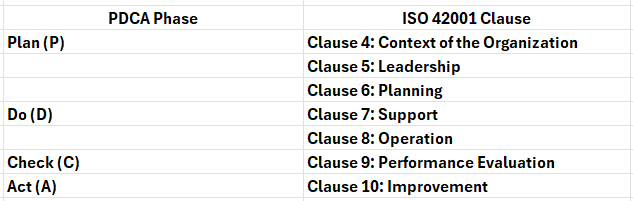
The standard follows ISO’s familiar High-Level Structure (HLS), making it compatible with other management system standards and easier to integrate into existing compliance frameworks. This structure consists of ten core clauses that guide organizations through establishing context, leadership requirements, planning, support mechanisms, operational controls, performance evaluation, and continuous improvement.
ISO 42001 alignment with the PDCA (Plan-Do-Check-Act) framework is as follows:
Key Components of ISO 42001
Clause 4: Context of the organization —
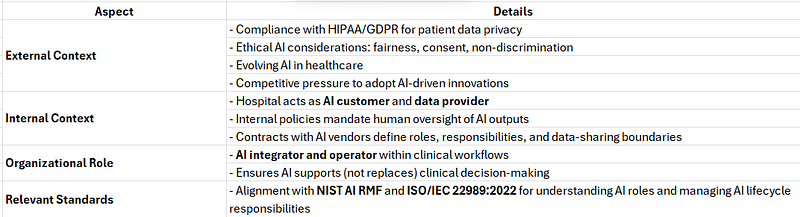
4.1 — Understanding the organization and its context
This includes determining the internal and external context of the organization and its intended purpose, specifically its role relative to the AI system. NIST AI 600–1 — AI Risk Management Framework (RMF) and ISO/IEC 22989:2022 explain the roles and their relation to the AI system lifecycle in detail.
Examples of external context can be legal/regulatory requirements related to AI, competition, AI landscape, Ethics, etc., and internal context can be contractual obligations, organization policies, etc.
Examples of different AI roles are AI customers who use the AI products, AI producers such as companies creating products and services using AI, AI platforms, and service providers
Let’s consider an example of an AI-powered medical diagnosis support system. This fictitious organization is a private multi-specialty hospital implementing an AI-powered diagnosis support tool to assist clinicians in interpreting radiology scans
4.2 — Understanding the needs and expectations of interested parties
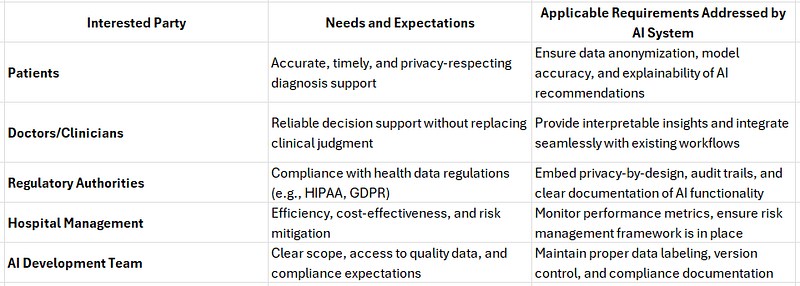
This clause talks about identifying who the interested parties are, what their expectations are, and which requirements can be addressed using the AI system. Expectations can be explicit or implied, and it is up to the organization to determine them. An example implementation of this clause for an AI-powered medical diagnosis support system in a healthcare setting can be as follows:
4.3 — Determine the scope of the AI Management System
This subclause requires the organization to determine the scope of the AI management system, taking into account 4.1 and 4.2 above. It also requires organization to determine the boundaries and applicability of the AI management system in its scope. They also require the scope to be maintained as a documented information. Example scope for our fictitious company providing an AI-powered medical diagnosis support system
The scope of the AI Management System (AIMS) covers the implementation, use, monitoring, and continual improvement of an AI-powered medical diagnosis support system used by the hospital’s radiology department. The AI system assists clinicians in interpreting diagnostic imaging (e.g., X-rays, CT scans) to improve diagnostic accuracy, efficiency, and patient outcomes.
This scope includes:
· Management of AI lifecycle activities such as data preparation, model validation, system deployment, and performance monitoring.
· Compliance with applicable legal and regulatory requirements (e.g., HIPAA, GDPR).
· Integration of the AI system into clinical workflows while maintaining human oversight.
· Alignment with organizational policies on ethics, transparency, data privacy, and risk management.
· Engagement with relevant stakeholders, including clinicians, hospital management, patients, AI development teams, and regulators.
The scope includes all activities necessary to meet the requirements of ISO/IEC 42001, including leadership responsibilities, planning and risk assessment related to AI use, allocation of resources and support, operational procedures for system deployment and integration, ongoing performance monitoring, and continual improvement processes.
The AIMS applies to all internal departments involved in the use and governance of the AI system and includes coordination with external AI vendors and service providers under contractual agreements.
The boundaries of the AIMS are limited to the AI system deployed for radiology support and do not extend to unrelated hospital functions or non-AI-based diagnostic tools.
Clause 4.4 — AI Management System
This clause explains that organizations need to maintain an AI management system in accordance with the ISO 42001 standard.
Having covered the introduction and Clause 4, which outlines the framework for the management system, our next installment will focus on Clause 5: Leadership, and Clause 6: Planning.
References
- **ISO 42001 — **Information technology — Artificial intelligence — Management system: https://www.iso.org/standard/81230.html
- NIST AI 600–1 : https://nvlpubs.nist.gov/nistpubs/ai/NIST.AI.600-1.pdf
- **ISO/IEC 22989 — **Information technology — Artificial intelligence — Artificial intelligence concepts and terminology: https://www.iso.org/standard/74296.html
Disclaimer
The content provided in this blog series is for informational purposes only and does not constitute legal, regulatory, or professional advice. While every effort has been made to ensure accuracy, readers are encouraged to consult the official ISO 42001 standard and relevant regulatory or industry experts for specific guidance. The views expressed are those of the author and do not necessarily reflect the opinions of any affiliated organizations.