
A look at key security frameworks from OWASP and CSA
Artificial Intelligence (AI) agents are transforming the technological landscape by enabling more autonomous and adaptive interactions. This blog post provides a comprehensive overview of Agentic AI, exploring its core components and the unique threats these systems introduce. Drawing on security frameworks from organizations like OWASP and the Cloud Security Alliance (CSA), we’ll discuss essential mitigation strategies and the precautions necessary for their responsible and secure deployment.
From Chatbots to AI Agents
We’ve seen Generative AI (GenAI) evolve significantly. It started with simple chatbots that answered questions based on pre-trained knowledge. Then came Retrieval-Augmented Generation (RAG), which let a large language model (LLM) augment its knowledge with external documents to provide more accurate, context-aware answers.
Now, we have AI agents, which are programs built on top of LLMs that can take action independently. Agents are autonomous, goal-driven, and can reason, plan a solution, and execute the best set of actions to achieve a human-defined objective. They can interact with their environment to gather information and make rational decisions. This gives them the ability to choose the right tools and refine their responses over time. For complex scenarios, multiple AI agents can even collaborate to automate a workflow.
Agent architecture has also evolved from a single-agent model, focused on simple tasks, to a multi-agent ecosystem that can perform complex workflows using multiple LLMs, tools, and personas, often referred to as Agentic AI systems.
Key Components of an AI Agent
An AI agent has several core components that allow it to function autonomously:
1. Perception: This is how an agent gathers information from its environment. It involves interpreting user inputs, extracting relevant information, and converting unstructured text into a structured format for processing. For example, a chatbot understands a user’s query, or a robot uses a camera to spot an object.
2. Reasoning & Decision-Making: This is the fundamental building block for an agent. Reasoning allows it to appropriately interact with its environment, use the required tools, and make autonomous decisions. LLMs are prompted to plan how to solve a task — for example, a bot deciding to issue a refund.
3. Memory: Memory allows agents to retain context and learn from past interactions. There are two types:
- Short-term memory: Maintains context within a single session, like remembering the current question or task.
- Long-term memory: The agent’s “filing system” to store what it learns to use later, such as preferences, experiences, self-awareness, facts, and skills.
4. Planning and Action Execution: Planning, which requires strong reasoning, involves breaking a task into subtasks. Action execution is the agent performing the steps from the plan using available tools.
5. Tools: Tools are external APIs or functions an agent can call to perform tasks like retrieving the weather, performing a search, or accessing a database. LLMs decide which tool to use and with what arguments, but they don’t execute the tools themselves — that’s handled by your code.
Agentic AI Threats and Mitigation
The rise of autonomous agents also introduces new security risks. Here’s a look at common threats and how to mitigate them, based on guidance from leading organizations like OWASP and the Cloud Security Alliance (CSA).
OWASP Agentic AI Threats & Mitigation Guide
OWASP provides detailed guidance on Agentic AI threats and mitigation. Beyond traditional threats, OWASP’s guidance focuses on those unique to agents:
- Agent Hijacking: An agent is fed malicious data, causing it to perform an unauthorized action. Mitigations include strict access controls, clear operational boundaries, and logging and monitoring.
- Confused Deputy Vulnerability: An agent is tricked into performing unauthorized actions on a user’s behalf, often because the agent has higher privileges than the user and lacks proper privilege isolation. Mitigations include scoped-down privileges when the agent acts on behalf of a user.
- Cascading Hallucination: An agent generates inaccurate information that is amplified across the workflow. This becomes more complex with multiple agents. Mitigations include using a “human-in-the-loop” approach to ensure verification and auditing of actions.
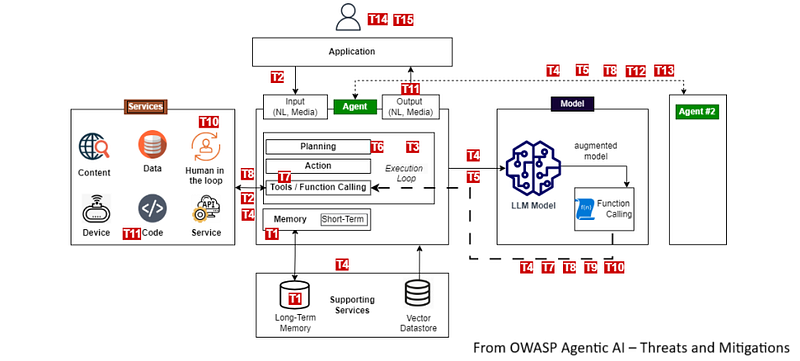
OWASP also provides a structured decision path for identifying agent threats. Here are the key questions and associated threats:
- Does the AI agent independently determine the steps needed to achieve its goals?
- Intent Breaking and Goal Manipulation (T6): Manipulates the agent’s decision-making, reasoning, and planning to cause unauthorized actions.
- Misaligned and Deceptive Behaviors (T7): Uses prompt injection to bypass constraints and cause agents to execute harmful actions. e.g., bypassing constraints for stock or chemical orders.
- Repudiation and Untraceability (T8): This happens when an AI agent acts autonomously without sufficient logging and monitoring controls. e.g., an attacker erasing unauthorized financial transactions.
2. Does the AI agent rely on stored memory for decision-making?
- Memory Poisoning (T1): Corrupts short-term or long-term memory, causing the agent to expose sensitive information or enable privilege escalation. e.g., implanting a false pricing rule into an AI travel agent’s memory.
- Cascading Hallucination (T5): False information propagates across multiple agentic systems, leading to incorrect actions. For instance, implanting false treatment guidelines into a medical AI’s response.
3. Does the AI agent execute actions using tools, system commands, or external integrations?
- Tools Misuse (T2): An attacker manipulates an agent to abuse its tool access, causing unauthorized data access (e.g., tricking an AI booking agent into reserving 500 seats instead of one).
- Privilege Compromise (T3): An agent’s privileges are abused to execute unauthorized access, such as deploying a rogue “shadow agent.”
- Resource Overload (T4): Similar to a DDoS attack, attackers can overload an agent, causing failures (e.g., Inference Time Exploitation).
- Unexpected Remote Code Execution (RCE) and Code Attacks (T11): An attacker exploits AI-generated code execution within an agentic system (e.g., a compromised DevOps agent).
4. Does the AI system rely on authentication to verify users, tools, or services?
- Identity Spoofing and Impersonation (T9): An attacker exploits the authentication mechanism to impersonate an agent, user, or service to gain unauthorized access (e.g., an HR agent creating fraudulent user accounts).
5. Does AI require human engagement to achieve its goals or function effectively?
- Overwhelming Human-in-the-Loop (T10): Overloading humans with excessive intervention requests, leading to decision fatigue.
- Human Manipulation (T10): Exploiting human trust to mislead individuals into taking unintended actions (e.g., an AI-driven phishing attack).
6. Does the AI system rely on multiple interacting agents?
- Agent Communication Poisoning (T12): Manipulating the inter-agent communication channel to inject false information and corrupt decisions.
- Rogue Agent (T13): A malicious agent is introduced into the system to manipulate decisions (e.g., injecting fraudulent transactions).
Agentic AI Threat Modeling with MAESTRO
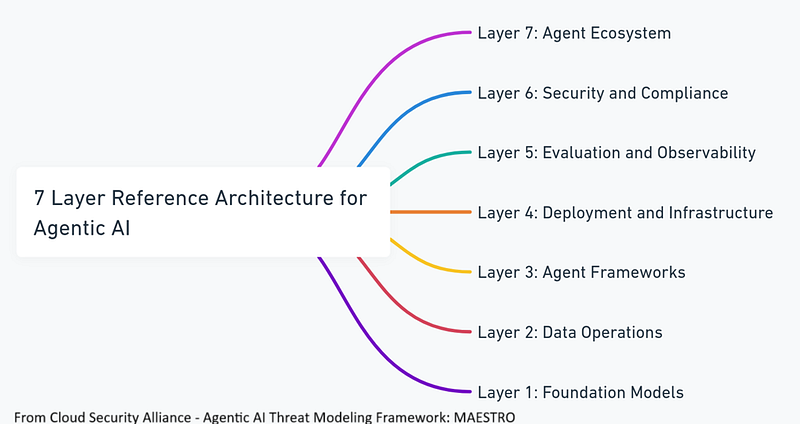
While OWASP provides a great foundation, other organizations are also developing comprehensive frameworks tailored to the complexities of multi-agent systems. The Cloud Security Alliance (CSA) offers a new threat modeling approach for Agentic AI called MAESTRO (Multi-Agent Environment, Security, Threat, Risk, and Outcome). It addresses the gaps in existing threat modeling methods by breaking down the Agentic AI architecture into seven layers to identify threats and mitigation for each.
Here is a high-level summary of MAESTRO’s layers:
1. Layer 1 — Foundation Models: The core AI models (LLMs, etc.) that power agents, vulnerable to data poisoning, adversarial prompts, and model theft.
2. Layer 2 — Data Operations: The data pipelines and storage systems that feed models, at risk of tampering, exfiltration, or denial of service.
3. Layer 3 — Agent Frameworks: The libraries and toolkits agents rely on, exposed to backdoors, supply chain attacks, and input exploits.
4. Layer 4 — Deployment & Infrastructure: The runtime environment (cloud, containers, orchestration) where agents operate, threatened by hijacking, DoS, and lateral movement.
5. Layer 5 — Evaluation & Observability: The monitoring and testing systems that track agent performance, which can be manipulated through biased metrics, hidden activity, or data leakage.
6. Layer 6 — Security & Compliance: The guardrails and controls that enforce safe operation can be vulnerable to poisoned security agents, evasion, bias, or regulatory compliance failures.
7. Layer 7 — Agent Ecosystem: Real-world interaction with users and tools, can be exposed to impersonation, goal manipulation, and marketplace abuse.
Because threats often cascade across layers, protection requires defense-in-depth: securing each layer, monitoring across the stack, and applying AI-specific safeguards like red teaming, explainability, and runtime safety checks.
Regulatory and Governance for AI Agents
Autonomous AI systems are under increasing regulatory scrutiny. The EU AI Act, for example, establishes a risk-based classification system and sets obligations for providers and users. Organizations must conduct a risk assessment to determine if an AI system falls under the high-risk category, which depends on its function and deployment.
This article has provided a high-level overview of the threats and mitigations in Agentic AI. As this field evolves, new and more complex threats will emerge, demanding equally sophisticated mitigations. While frameworks like OWASP and MAESTRO provide essential guidance, the core principles of cybersecurity will always apply. By staying proactive and adopting a defense-in-depth approach, we can build a safer, more secure future for autonomous AI.
References
- AI Agents: Evolution, Architecture, and Real-World Applications
- The Landscape of Emerging AI Agent Architectures for Reasoning, Planning, and Tool Calling: A Survey
- Building Multimodal AI Agents From Scratch — Apoorva Joshi, MongoDB
- OWASP — Agentic AI — Threats and Mitigations
- NIST Technical Blog: Strengthening AI Agent Hijacking Evaluations
- CSA — Agentic AI Threat Modeling Framework: MAESTRO
- TRiSM for Agentic AI: A Review of Trust, Risk, and Security Management in LLM-based Agentic Multi-Agent Systems
- High-level summary of the EU AI Act
Disclaimer
This blog contains research and information from various sources. The views and opinions expressed are those of the author and do not necessarily reflect the views of any affiliated organizations. All content is for informational purposes only. AI tools were used for research, structure, and editing, but all final content was generated and verified by a human.